Media Release: NACC NRM joins NRM leaders in voicing regional priorities to Parliament House

NACC NRM joins WA’s regional NRM leaders in travelling to Canberra to advocate directly for the regions and call for sustained Commonwealth investment in regional natural resource management.
Home 🞂 Newsroom 🞂 Media Release: NACC NRM joins NRM leaders in voicing regional priorities to Parliament House

Canberra, 16 September 2026: Regional NRM leaders from across Western Australia have presented their regions’ priorities to Parliament House, pushing for long-term natural resource management investment directly to senators, MPs and federal decision-makers.

Representing communities and landscapes across the state, CEOs from WA NRM regional groups came together in Canberra this week to highlight the critical role regional NRM organisations play in delivering environmental and agricultural outcomes, and to advocate for the continuation of the regional capability that makes this work possible.
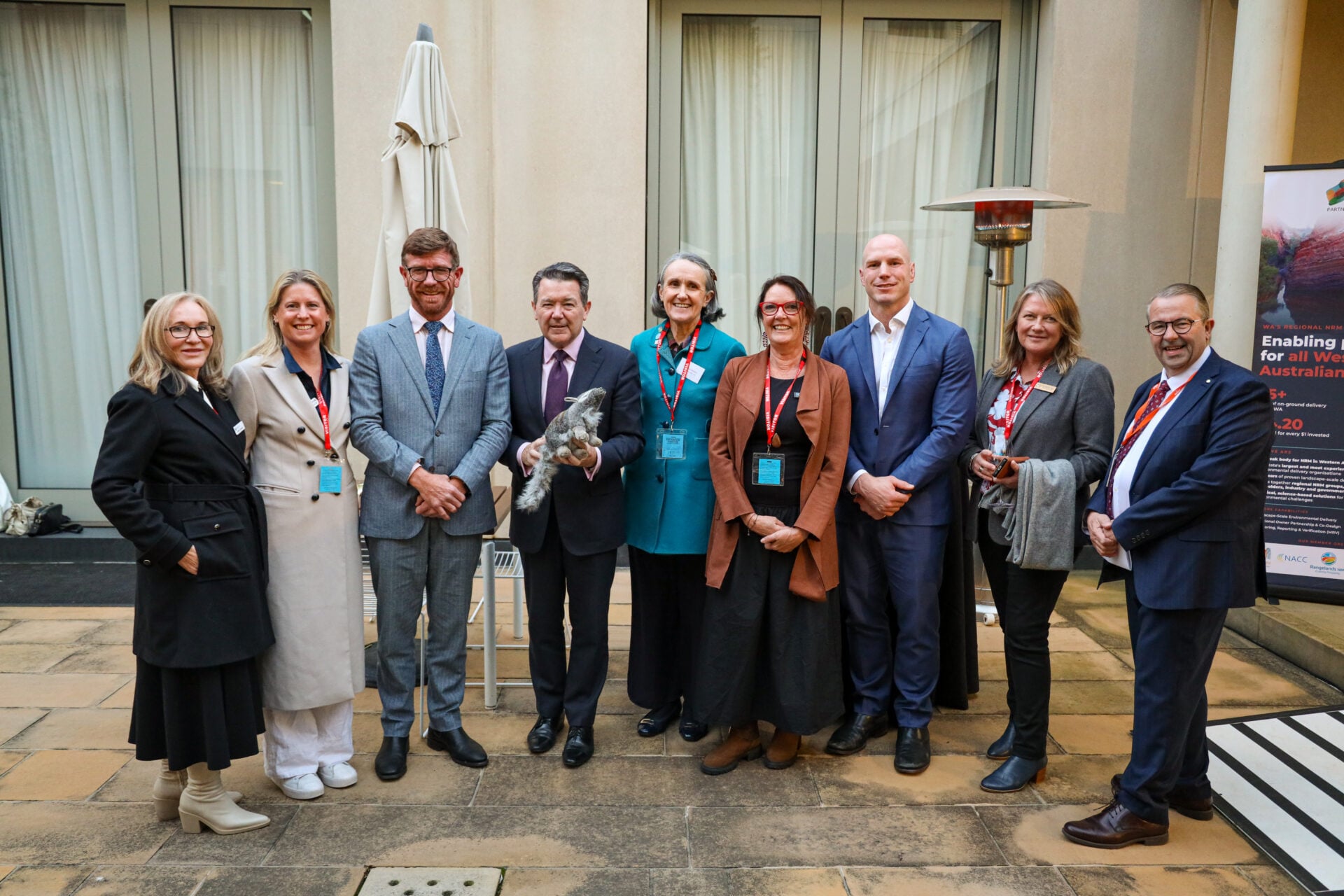
WA’s regional NRM leaders (from left): Debra Tarabini, Katherine Allen, Darren Forster, Senator Dean Smith, Renata Paliskis, Jane O'Malley, Senator David Pocock, Dr Manda Page, Jon Hart.

The event was hosted by the office of Senator the Hon Slade Brockman, Deputy President of the Senate, co-convened by Senator Varun Ghosh and emceed by Senator Dean Smith. Attendees included Senator the Hon Anthony Chisholm, Assistant Minister for Resources, Regional Development and Agriculture, Fisheries and Forestry; Senator David Pocock; Rick Wilson MP, Member for O’Connor; and Kate Chaney MP, Member for Curtin, together with other senators and members of Parliament.

NACC NRM CEO Katherine Allen joined NRM WA at the Partnering for Prosperity reception in the Senate Courtyard on Wednesday 16 September, where regional leaders met with parliamentarians and outlined the priorities facing their regions.

The delegation’s message was clear: regional NRM organisations are already working on the ground with the people who know their landscapes best, and sustained investment is needed to maintain the relationships, knowledge and capability behind that work.

“We wanted to put a face to the work happening across Western Australia and make it clear that organisations like NACC NRM have both the experience and the capability to deliver lasting outcomes,” Mrs Allen said.

For NACC NRM, that work extends across the Northern Agricultural Region, encompassing biodiversity conservation, sustainable agriculture, coastal and marine environments and Aboriginal custodianship. NACC NRM works alongside Traditional Owners, landholders, farmers, community groups, industry, researchers and government to support practical action across a vast and diverse landscape.

Senator for Western Australia Varun Ghosh said NRMWA’s work is vital to safeguarding WA’s unique natural assets.

“Western Australia has the most beautiful and diverse natural environment in the world. It is vital for the health and prosperity of our great state that our environment is protected for future generations. The hard work, diligence and expertise of Natural Resource Management WA play a critical role in this endeavour.”

From protecting threatened species and restoring remnant habitat to improving soil health, supporting sustainable farming practices and caring for coastal and wetland environments, much of this work relies on relationships and knowledge built and nurtured over many years.

“Our regions are a long way from Canberra, but the environmental challenges we are working on are nationally significant. Being here gives us an opportunity to speak directly with decision-makers about what our communities need and what it takes to deliver meaningful environmental outcomes on the ground,” said Mrs Allen.

The regional NRM network is advocating for greater continuity in Commonwealth investment, highlighting the risks associated with short-term and stop-start funding. When funding programs conclude, not only do the environmental challenges they address remain, but there can also be significant impacts to the regional workforce, community participation, monitoring programs and relationships with landholders and Traditional Owners.

“The recovery of threatened species, restoration of habitat, improvement of soil health and strengthening of community capacity all take sustained effort. Long-term investment allows us to build on progress rather than continually starting over,” said Mrs Allen.

Western Australia’s seven regional NRM organisations are approved Commonwealth Regional Delivery Partners, providing an established pathway for government to commission regional work. The regional network is calling for the existing Regional Delivery Partners arrangements to be used to support coordinated, multi-year investment in priorities across Western Australia.

Senator Dean Smith said regional NRM provided an essential link between government investment and people with the local knowledge to deliver.

“NRM organisations provide the vital bridge between government policy and practical results, connecting investment with the people who know the country and are best placed to deliver,” Senator Smith said.

For NACC NRM, sustained regional investment supports the continuity needed to build on work already underway across the Northern Agricultural Region and respond to emerging environmental and agricultural challenges.

The Canberra visit marks an important step for NRM WA leaders to strengthen direct dialogue with federal decision-makers and ensure regional perspectives remain part of conversations about Australia’s environmental and agricultural future.

NACC NRM will continue working alongside its regional NRM partners to advocate for investment that supports strong regional communities, healthy landscapes and lasting environmental outcomes.

Next Steps

NACC NRM and NRMWA will follow up with parliamentary offices and Commonwealth departments within the next four weeks. They will seek a nominated Commonwealth lead and a program-design meeting to scope a coordinated multi-year work package through the Regional Delivery Partners Panel.

All seven of WA’s NRM groups have strong delivery and governance arrangements in place. This presents an exciting opportunity for the WA Government to establish a statewide core-funding arrangement and engage consistently with regional NRM groups across our vast state. Western Australia is the only jurisdiction without a statewide core-funding arrangement for regional NRM delivery.

NRMWA thanked Senator Brockman and his office for hosting the event, Senator Ghosh for co-convening, Senator Smith for serving as Master of Ceremonies, and the senators and MPs who met with the regional delegation.

ENDS

Media Contact
Phoebe Royce | Senior Communications Officer, NACC NRM
T (08) 9938 0105 | E phoebe.royce@nacc.com.au

About NACC NRM
For more than 30 years, NACC NRM has been catalysing community conservation across the Northern Agricultural Region which spans 7.5 million Ha from Kalbarri to Guilderton and inland to Perenjori and Dalwallinu. NACC NRM works alongside Traditional Owners, landholders, community groups, industry, researchers and government through core programs Aboriginal Custodianship, Biodiversity, Coastal & Marine and Sustainable Agriculture.

About NRMWA
NRMWA is the peak body for Western Australia’s independent, regionally governed natural resource management organisations. Together, the network has more than 25 years of on-ground experience and has delivered more than $700 million in regional environmental and agricultural programs. All seven regional groups are approved Commonwealth Regional Delivery Partners.

Share

We'd Love to Hear From You!

Your feedback is important to us. If you have suggestions, questions, or would like to get involved in Natural Resource Management, please use the form below or contact our Geraldton office. We’re here to listen and help

Geraldton Office

4 Walton Close, Geraldton
Post: PO Box 7168, Geraldton, 6531
Phone: (08) 9938 0100
Office hours: 8:30am to 4:30pm

Forms

Expression of Interest Form 🞂

Suggest a Project Form 🞂

Membership Form 🞂

Donations Form 🞂

Contacts

NACC Board Members 🞂

NACC Staff 🞂

NRM Bodies & Groups 🞂

CEO’s Report

In 2020-21 I talked about ‘raising the bar’. In 2021-22 we worked on setting the bar on fire. Over the last 12 months, the team at NACC NRM has not stopped.

The Sustainable Agriculture team has extended the program’s reach through collaborations with grower groups in the regions. Specifically, the Beyond Reasonable Drought project and Grower Group Alliance – South West WA Drought Innovation Hub – Geraldton Node project. The Beyond Reasonable Drought partnership with grower groups supported farmers across the region to improve the environmental sustainability of their agricultural production and drought resilience. The outcomes of this project have been consolidated through our successful Expression of Interest to the South West WA Drought Innovation Hub, with support from grower groups across the region, to host the Geraldton Node of the Hub. The program continues to focus on working with agricultural networks to share technical expertise and provide opportunities that will improve land management practices in agriculture across the region.

The conservation outcomes of ranger teams have expanded through work on several land tenures. Maintaining Heritage sites such as Willi Gulli, Racecourse Paddock and Buller River has long been a priority. During 2021-22, the teams have increasingly focused on threatened species and ecosystems.

To this end, Western Mulga rangers have improved management across 19,000 ha for the conservation of Malleefowl through firebreak and access management. They completed the maintenance of water holes and supported the monitoring of over 90 Malleefowl mounds.

Similarly, the Kwelena Mambakort Aboriginal Corporate ranger team have contributed positively to Carnaby’s Black Cockatoo populations by installing artificial hollows and habitat restoration.

All ranger teams have collected native seed, propagated native plants for restoration, and planted native vegetation in key locations across the NAR. Seed collection provides valuable industry experience and has facilitated the planting of over 100,000 seedlings during the year.   

In September 2021, the NACC NRM team delivered the WA Threatened Species Forum, held in tandem with the National Malleefowl Forum. Given the impact of COVID and the timing of this event, having more than 100 delegates from all over Australia was a significant achievement. The two Forums brought together 12 events over five days and featured 14 local artists, 25 businesses and 36 youth participants.

Following the successful relaunch of our updated NARvis, NACC NRM was invited to help lead a significant piece of strategic planning work for the region with Mid West Development Commission and the Department of Primary Industries and Regional Development. With funding from the Australian Government’s Future Drought Fund, the consortia delivered a Regional Drought Resilience Plan covering the shires of Northampton and Chapman Valley and the City of Greater Geraldton, along with significant technical analysis of drought vulnerability for the South West land division. The development of this plan also included extensive community consultation to ensure that local knowledge and technical advice guided the development of priorities for action.

This planning work links to existing NACC NRM on-ground projects, including Beyond Reasonable Drought and the Chapman Catchment Collaborative regeneration project.

It was a busy year for events with face-to-face events becoming commonplace again. During 2021-22 we hosted events in Gingin, Moora, Dalwallinu, Cervantes, Jurien Bay, Walkaway, Nabawa, Perenjori, Kalannie and Morawa. We supported events in Karakin, Thundellara, Perenjori, Paynes Find, Wubin, Cataby, Warradarge, Northampton, Yuna, Dalwallinu and Dandaragan.

We also supported on-ground works throughout the region, including at the following locations Yuna, Dalwallinu, Dandaragan, Merkanooka, Goodlands, Kalannie, Bunjil, Yardarino, Canna, Kondut, Latham, Kadathinni, Nabawa, Red Gully, Sandy Gully, Waddy Forrest, Devils Creek, Perenjori, Bowgada, Ellendale, Wandana, Namban, Hill River, Warradarge, Gillingarra, Regans Ford and Moonyanooka.

Our region is vast – slightly larger than Tasmania, which for comparison, is serviced by three separate NRM organisations. Covering the NAR region and its many environmental threats is challenging. We continue to focus on partnerships and collaboration to address this challenge. We know that by working with our community through passionate delivery of collaborative on-ground projects and education, the community will value and actively protect our region’s natural capital.

This year we have launched a new Reconciliation Action Plan (RAP). The RAP Working Group consulted widely and developed an Innovate RAP which Reconciliation Australia approved in March 2022. The activities to fulfil these commitments are now in full swing.

Sadly, at the end of 2021, we farewelled former NACC NRM CEO Shelley Spriggs, who lost a long battle with cancer. Shelley was an inaugural inductee to the NRM Leadership Honour Roll. I will always be grateful for her guidance and no-nonsense approach, not to mention her passion for life.

While we have said farewell to some, we have welcomed many new faces across all programs, including our Administration team. We have also hosted a school-based trainee from Nagle Catholic College who has been working towards a Certificate II in Conservation and Ecosystem Management. This trial position has been very successful, and we look forward to making this opportunity available again in 2023.

During 2022 we have taken on new projects that align with our organisational and program objectives, and we have successfully completed some great initiatives that support continued conservation and sustainability outcomes. I want to thank the whole team who continue to go above and beyond for the organisation and each other proving their ongoing commitment to our purpose and our values.