
Between May and November, WA’s humpbacks are on the move. From June to August, they head north to the calving grounds of the Kimberley, before returning south from August to November, often accompanied by newborn calves who hug the coastline for protection. These migrations follow a fascinating sequence; females finishing lactation migrate first, followed by juveniles and males, and finally pregnant females. This sequence reverses on the return journey south.
Along the way, mothers and calves seek calm, shallow habitats for safe rest amid the long journey. Key ‘stopover’ areas along WA’s coast include the Lacepede Islands, the Exmouth Gulf and Shark Bay.
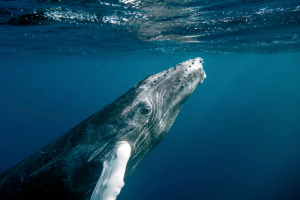
Photo: Christopher Michael, 2014
Humpback whales can grow up to 17.4 metres in length and weigh as much as 45 tonnes. They are easily recognised by their long pectoral fins, knobbly tubercles on their heads, and a distinctive humped dorsal fin. Each individual whale has unique white-and-black patterns on the underside of its tail fluke, much like a fingerprint. Male humpbacks are well known for their complex songs, which can be heard over several kilometres underwater.
Megaptera novaeangliae is currently listed as ‘Vulnerable’ under Australia’s EPBC Act and ‘Specially Protected’ under WA legislation. Once decimated by whaling, both the east and west coast populations are now recovering – a true conservation success story – but still face threats including climate change and habitat degradation, noise pollution and vessel strikes, marine debris, and entanglement in fishing gear.
Did You Know?
A Humpback Whale’s song can last for hours and be heard over kilometres underwater.
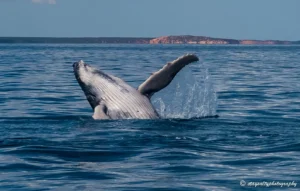
Photo: Mason Sullivan, 2017
Western Australia’s whale-watching guidelines are designed to protect humpback whales and ensure we interact with them safely and respectfully. Vessels must maintain a minimum distance of 100 metres from whales, and at least 300 metres if approaching from directly in front or behind. It’s crucial not to separate mothers from their calves, and if a whale approaches your vessel, the motor should be placed in neutral and the vessel moved slowly away at less than six knots. Touching, swimming with, or feeding whales is strictly prohibited, as these actions can cause distress and pose a danger to both whales and people. By following these simple rules, we can all help ensure that human activity doesn’t become another obstacle in the whales’ long and remarkable journey.
Ongoing research and monitoring are playing a vital role in understanding and protecting these gentle giants. Through satellite tracking, aerial surveys, and long-term monitoring projects like those in Pender Bay, scientists have gained valuable insights into how humpback whales migrate, breed, and respond to environmental pressures. Leading this work, the WA Marine Science Institution and researchers such as Mark Meekan from AIMS are identifying critical habitats, assessing potential threats, and informing smarter conservation strategies.