
Over time, Pyrorchis nigricans has adopted many names including Red Fire Orchid, Undertaker Orchid, and Elephant’s Ears. It is part of a unique group of native orchids that respond dramatically to fire. Though foliage often appears annually, flowering is largely dependent on hot summer fires, meaning sightings are rare and unpredictable. Even in long-observed colonies, flowering events can be more than a decade apart.
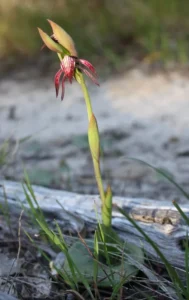
Pyrorchis nigricans – Friends of Aldinga Scrub, 2011
The genus name Pyrorchis – from the Greek pyr (fire) and orchis (orchid) – reflects this botanical pyrophilia. When conditions align, flowering occurs from August to November, with some exceptions where mowing or other disturbances may stimulate blooms.
Red Beak is a terrestrial, deciduous orchid with a single fleshy, heart- to oval-shaped leaf that grows flat on the ground. The leaf is dark green, often marked with red or black blotches, hence the nickname Elephant’s Ears. When in bloom, the plant produces up to eight flowers of red and white on a stem that reaches up to 30cm in height. Each flower features a fringed labellum and striped sepals. As the plant ages or dries, all its parts gradually turn jet black – a feature that inspired its species name nigricans, Latin for “blackish”, and earned it the lesser known signature ‘Undertaker Orchid’.
While their appearance may be fleeting, Red Beaks are not delicate. These plants form extensive underground tuber colonies, allowing them to persist for years, even decades, without flowering. When fire finally triggers a bloom, colonies may erupt in dense, synchronized displays that draw in native pollinators. Small native bees, such as Homalictus punctatus, have been observed visiting the flowers. These bees crawl deep into the flower, emerging with pollinia attached to their thorax, ensuring the next bloom cycle is more robust than the last.

Red Beak Orchid – J & F Hort, 2012
Red Beaks are widely distributed across Australia, except for Queensland and the Northern Territory. They thrive in a variety of habitats – coastal scrub, heathy forest, open woodlands, and mallee shrubland – often on well drained soils. In Western Australia, Pyrorchis nigricans is especially prevalent from Shark Bay to Israelite Bay, flowering dramatically in fire affected reserves like Wireless Hill Park near Perth.
This year’s National Reconciliation Week campaign artwork from Bree Buttenshaw, a Kalkadoon artist, focuses on native plants and their ability to regenerate after fire, a symbol of resilience collective strength. Though not rare, this orchid is a master of disguise, its remarkable beauty hidden in plain sight until awakened by fire. Its unique life cycle is a reminder of the intricate relationships between flora and fire in Australia’s ecosystems.
NACC NRM is a member of the Commonwealth Regional Delivery Partnership panel and has promoted this initiative with funding by the Australian Government Natural Heritage Trust.