
These impressive birds of prey grow up to 60cm long, can weigh up to 2kg, and boast a wingspan of up to 1.8 metres. Their striking black facial markings stretch from the throat to the eye, giving them a distinctive look. Females are typically larger than males, and both have a special third eyelid (called a nictitating membrane) that acts like built-in goggles and allows them to see clearly underwater.
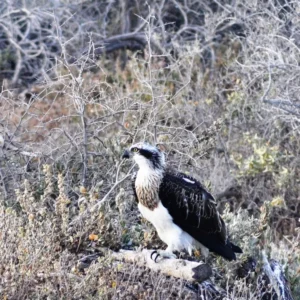
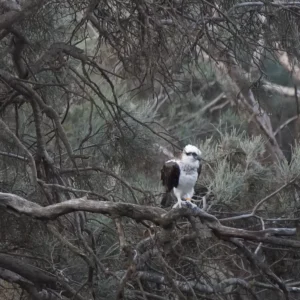
As their nicknames suggest, ospreys are seafood specialists. They hunt live fish, diving up to one metre deep to snatch their prey with sharp talons before returning to a perch to eat.
Ospreys usually mate for life, reaching maturity around three to four years of age. Breeding pairs build large nests made of sticks, seaweed, and driftwood, often returning to the same site each year to add new layers. Over time, these nests can grow to over two metres wide and be used by multiple generations. Females lay two to three eggs, incubating them for about 40 days, while the male counterpart keeps busy finding food.
You’ll often find Eastern Ospreys along coastal areas, estuaries, islands, and open river systems, anywhere with good fishing opportunities and minimal human disturbance.
In Geraldton, ospreys are known to nest at Point Moore. Western Power recently donated old power poles to community groups in both Geraldton and Lancelin, where they are being repurposed as nesting platforms and giving these magnificent birds a safe and elevated place to raise their young.
Majestic, resourceful, and perfectly adapted to life by the sea, the Eastern Osprey is a true coastal icon!