
#CreatureFeature – Tarsipes rostratus (Honey Possum)

Also known by its Noongar name, Noolbenger, this tiny marsupial defies almost every standard rule of mammalian biology.
Home 🞂 Newsroom 🞂 #CreatureFeature – Tarsipes rostratus (Honey Possum)

If you head into the diverse sandplain heathlands and woodlands of southwest Western Australia, you might catch a glimpse of one of the world's most extraordinary evolutionary wonders - the Honey Possum.

Known natively by its Noongar name, Noolbenger, this tiny marsupial defies almost every standard rule of mammalian biology. Weighing little more than two teaspoons of sugar (7 to 10 grams), the Noolbenger is a hyper-specialised dynamo that keeps our native bushlands thriving.

The Honey Possum holds a prestigious title; it is the world’s only entirely nectar-eating land mammal. While some bats and birds live on nectar, the Noolbenger is the only flightless mammal that gets 100% of its food and water from flowers.
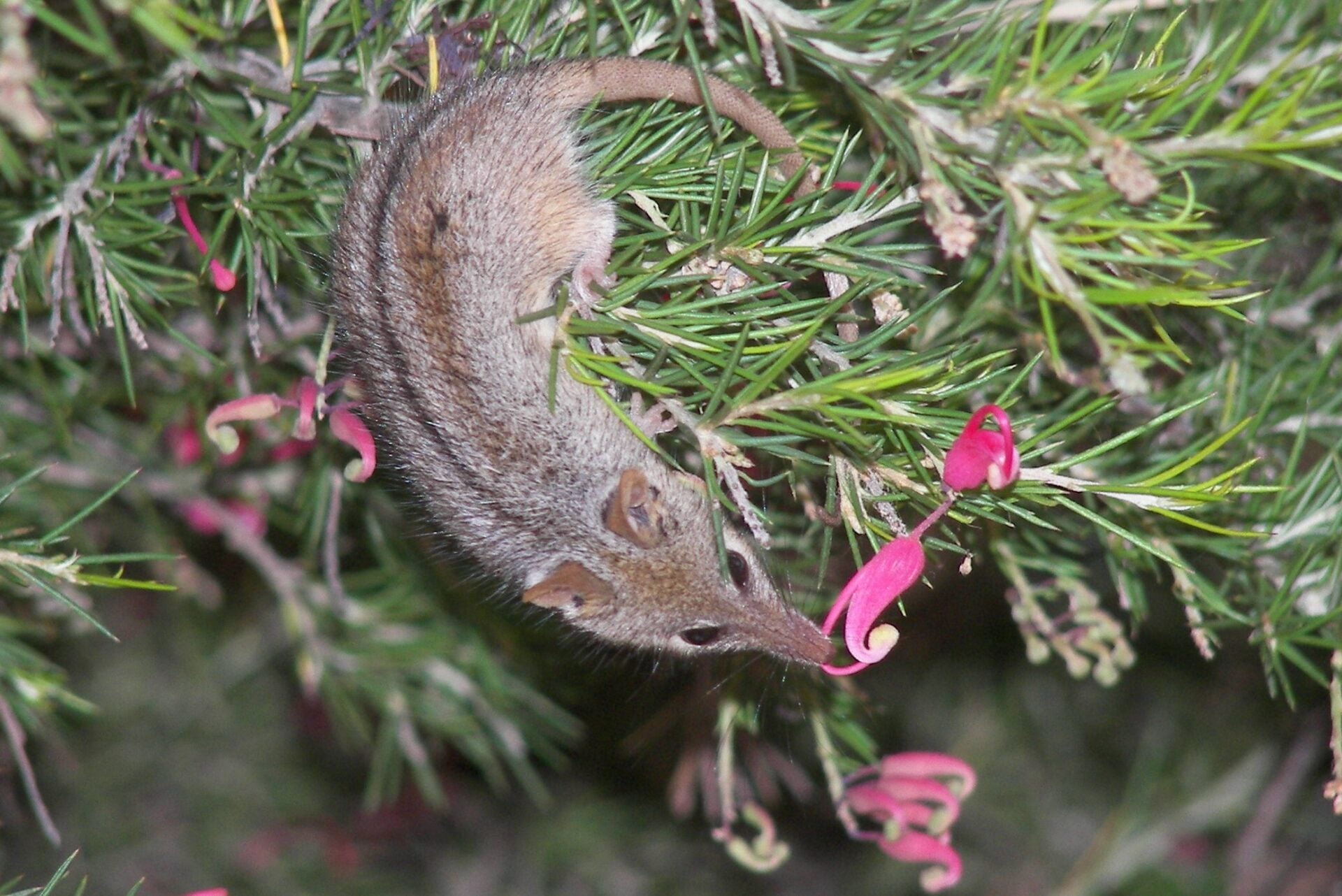
Honey Possum - Kelly Stephens

Because of an incredibly high metabolic rate, a single Honey Possum drinks up to 7 ml of nectar every day. Proportionally, that would be like a human gulping down 50 litres of soft drink daily! To survive on nothing but liquid sugar and dustings of protein-rich pollen, the Honey Possum has evolved a suite of highly specific physical tools:

  • The Bristle-Tongue: Its tongue can extend up to 1.8 cm, nearly the length of its own head and features brush-like bristles at the tip to mop up nectar out of deep tube flowers. It can flick this tongue in and out three times every second!
  • The Mouth Comb: Since it doesn’t eat solid foods, its teeth have shrunk into tiny, redundant pegs. Instead, it uses specialized comb-like structures on the roof of its mouth to scrape pollen off its tongue.
  • An Extra Hand: It sports a fully prehensile tail that is longer than its entire head and body combined, using it like a fifth limb to anchor onto swaying flower spikes while feeding.


Beyond its diet, the Noolbenger holds a few world records in reproductive biology:

  • Rice-Grain Babies: When a female gives birth, the newborns are the smallest of any known mammal, weighing a microscopic 4 milligrams-the size of a single grain of rice.
  • Sperm Giants: Conversely, the males possess the longest spermatozoa and largest relative testes size of any mammal on Earth (accounting for up to 4.2% of their total body weight).


Because Honey Possums rely on a relentless, year-round conveyor belt of blooming flowers, they are incredibly sensitive to habitat disruption. If a fire or land clearing wipes out a patch of heathland, the local population cannot simply swap diets; they can face rapid local extinction.

Protecting critical native corridors, managing controlled burns carefully, and controlling feral predators (like cats and foxes) ensure this tiny Western Australian treasure can continue its crucial job as a master pollinator for generations to come.

Genevieve Rusch - Workplace Learning Student

Share

We'd Love to Hear From You!

Your feedback is important to us. If you have suggestions, questions, or would like to get involved in Natural Resource Management, please use the form below or contact our Geraldton office. We’re here to listen and help

Geraldton Office

4 Walton Close, Geraldton
Post: PO Box 7168, Geraldton, 6531
Phone: (08) 9938 0100
Office hours: 8:30am to 4:30pm

Forms

Expression of Interest Form 🞂

Suggest a Project Form 🞂

Membership Form 🞂

Donations Form 🞂

Contacts

NACC Board Members 🞂

NACC Staff 🞂

NRM Bodies & Groups 🞂

CEO’s Report

In 2020-21 I talked about ‘raising the bar’. In 2021-22 we worked on setting the bar on fire. Over the last 12 months, the team at NACC NRM has not stopped.

The Sustainable Agriculture team has extended the program’s reach through collaborations with grower groups in the regions. Specifically, the Beyond Reasonable Drought project and Grower Group Alliance – South West WA Drought Innovation Hub – Geraldton Node project. The Beyond Reasonable Drought partnership with grower groups supported farmers across the region to improve the environmental sustainability of their agricultural production and drought resilience. The outcomes of this project have been consolidated through our successful Expression of Interest to the South West WA Drought Innovation Hub, with support from grower groups across the region, to host the Geraldton Node of the Hub. The program continues to focus on working with agricultural networks to share technical expertise and provide opportunities that will improve land management practices in agriculture across the region.

The conservation outcomes of ranger teams have expanded through work on several land tenures. Maintaining Heritage sites such as Willi Gulli, Racecourse Paddock and Buller River has long been a priority. During 2021-22, the teams have increasingly focused on threatened species and ecosystems.

To this end, Western Mulga rangers have improved management across 19,000 ha for the conservation of Malleefowl through firebreak and access management. They completed the maintenance of water holes and supported the monitoring of over 90 Malleefowl mounds.

Similarly, the Kwelena Mambakort Aboriginal Corporate ranger team have contributed positively to Carnaby’s Black Cockatoo populations by installing artificial hollows and habitat restoration.

All ranger teams have collected native seed, propagated native plants for restoration, and planted native vegetation in key locations across the NAR. Seed collection provides valuable industry experience and has facilitated the planting of over 100,000 seedlings during the year.   

In September 2021, the NACC NRM team delivered the WA Threatened Species Forum, held in tandem with the National Malleefowl Forum. Given the impact of COVID and the timing of this event, having more than 100 delegates from all over Australia was a significant achievement. The two Forums brought together 12 events over five days and featured 14 local artists, 25 businesses and 36 youth participants.

Following the successful relaunch of our updated NARvis, NACC NRM was invited to help lead a significant piece of strategic planning work for the region with Mid West Development Commission and the Department of Primary Industries and Regional Development. With funding from the Australian Government’s Future Drought Fund, the consortia delivered a Regional Drought Resilience Plan covering the shires of Northampton and Chapman Valley and the City of Greater Geraldton, along with significant technical analysis of drought vulnerability for the South West land division. The development of this plan also included extensive community consultation to ensure that local knowledge and technical advice guided the development of priorities for action.

This planning work links to existing NACC NRM on-ground projects, including Beyond Reasonable Drought and the Chapman Catchment Collaborative regeneration project.

It was a busy year for events with face-to-face events becoming commonplace again. During 2021-22 we hosted events in Gingin, Moora, Dalwallinu, Cervantes, Jurien Bay, Walkaway, Nabawa, Perenjori, Kalannie and Morawa. We supported events in Karakin, Thundellara, Perenjori, Paynes Find, Wubin, Cataby, Warradarge, Northampton, Yuna, Dalwallinu and Dandaragan.

We also supported on-ground works throughout the region, including at the following locations Yuna, Dalwallinu, Dandaragan, Merkanooka, Goodlands, Kalannie, Bunjil, Yardarino, Canna, Kondut, Latham, Kadathinni, Nabawa, Red Gully, Sandy Gully, Waddy Forrest, Devils Creek, Perenjori, Bowgada, Ellendale, Wandana, Namban, Hill River, Warradarge, Gillingarra, Regans Ford and Moonyanooka.

Our region is vast – slightly larger than Tasmania, which for comparison, is serviced by three separate NRM organisations. Covering the NAR region and its many environmental threats is challenging. We continue to focus on partnerships and collaboration to address this challenge. We know that by working with our community through passionate delivery of collaborative on-ground projects and education, the community will value and actively protect our region’s natural capital.

This year we have launched a new Reconciliation Action Plan (RAP). The RAP Working Group consulted widely and developed an Innovate RAP which Reconciliation Australia approved in March 2022. The activities to fulfil these commitments are now in full swing.

Sadly, at the end of 2021, we farewelled former NACC NRM CEO Shelley Spriggs, who lost a long battle with cancer. Shelley was an inaugural inductee to the NRM Leadership Honour Roll. I will always be grateful for her guidance and no-nonsense approach, not to mention her passion for life.

While we have said farewell to some, we have welcomed many new faces across all programs, including our Administration team. We have also hosted a school-based trainee from Nagle Catholic College who has been working towards a Certificate II in Conservation and Ecosystem Management. This trial position has been very successful, and we look forward to making this opportunity available again in 2023.

During 2022 we have taken on new projects that align with our organisational and program objectives, and we have successfully completed some great initiatives that support continued conservation and sustainability outcomes. I want to thank the whole team who continue to go above and beyond for the organisation and each other proving their ongoing commitment to our purpose and our values.