
Why do farmers need greenhouse gas (GHG) accounts?
Dive into Topic 3 of DAFF’s Carbon Farming Outreach Program training to learn how a greenhouse gas (GHG) account quantifies and records your GHG emissions and carbon storage. This topic will help explain GHG accounting and the reasons for doing it, which include being able to quantify productivity improvements and other co-benefits of carbon farming.
Why is this important? Well, as this training program highlights: “If selling produce internationally, farmers may need GHG accounts to demonstrate their emissions management credentials.” As we get closer to 2030 and 2050, when Paris Agreement reporting milestones kick in, major international companies who buy produce from Australia will increasingly want to know about all of their suppliers’ emissions. So now is the time to start getting to grips with the data they’ll want, and to begin keeping those records.
When it comes to understanding emissions, you might be wondering, “how am I support to measure emissions?”
Well, you don’t – it’s more a case of calculating them. There’s been a lot of research, trial and error and testing to build simple and reliable calculation tools that you can use, with a range of different calculators available depending on what you grow and why you want to record your emissions. If you have stats to hand such as your property size, land use, location, livestock numbers, power and chemical inputs, etc, then you’re most of the way there.
Did You Know?
A recent study on greenhouse gas emissions in grain farming systems has confirmed that fertiliser is by far the biggest contributor. Graphs from three DPIRD Western Australian Farming Systems projects sites at Northampton, Merredin and Lake Grace tell a compelling story.
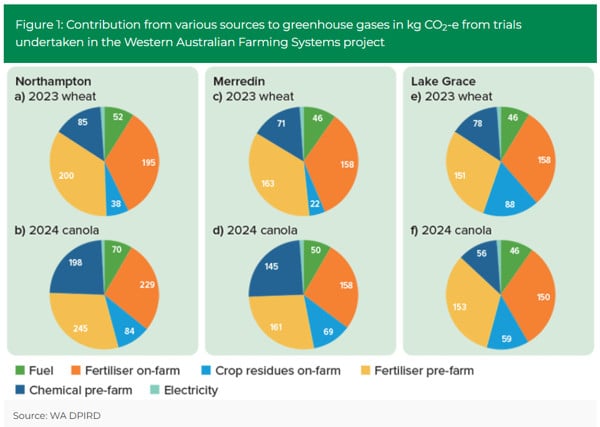
You can read more about this story here: Trials and simulations confirm fertiliser the biggest emissions contributor And see also this related article in GRDC Groundcover: National baseline and GHG emission sources.
To continue to work through this topic and learn more about the many emissions calculators available for your use, here’s your link: Topic 3 Your greenhouse gas account. Handy resources for you along the way:
- PDF training manual
- Glossary – keep this page handy to decode any words or phrases you’re not yet familiar with.
The Future Farm Foundations project is supported by the Australian Government through funding from the Natural Heritage Trust under the Climate-Smart Agriculture Program.