Forum sheds light on climate change and agriculture

Home 🞂 Newsroom 🞂 Forum sheds light on climate change and agriculture

12 February 2016

Coorow was a melting pot of information about agricultural innovation and climate science at the recent Productive Farming Futures Forum organised by NACC.

Amangu/Badimia Yamaji and NAIDOC Elder of the Year Mr Graham Taylor 2015 welcomed the full house – more than 70 guests – who attended the event.

For honoured guest and keynote speaker, Australia’s national Advocate for Soil Heath, Major General the Honourable Michael Jeffery, the solution to maintaining productivity in the face of climate change is firmly imbedded in soil health. “Good soil management underpins a sustainable, profitable and more secure future for us all, in a world with a changing climate and more intense economic demands,” he said. ”To save the planet, save the soil”.

The forum brought together a wide range of presenters – from industry, government organisations, research institutions and local farmers – all of whom are tackling the issue of climate change from different perspectives, but with the same goal – adaptation.
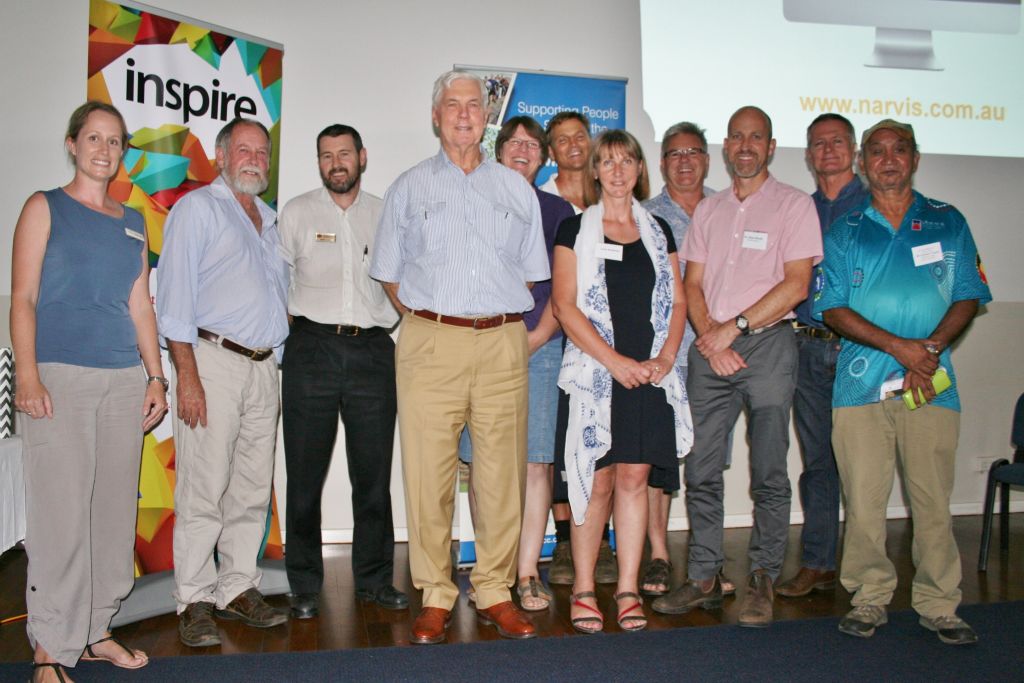
Productive Farming Futures Forum 157

The forum was focused on seeking-out opportunities in agriculture in a changing climate, highlighting a range of different techniques that farmers in the Northern Agricultural Region are using to adapt to climate change and creating local solutions to a global issue.

Senior meteorologist at the Bureau of Meteorology, Glenn Cook kicked-off presentations with a summary of the long-term climate trends in Southwest Australia, noting that overall the region is drying and warming.

Lucy Anderton then looked at the issue from a business point of view, highlighting the risks and rewards of farm management decisions, and how investing in new technology and adoption of best practise methodologies drives growth.

So what is best practice in a changing climate? Dr Dean Revell presented the results from grazing industry farm trials, demonstrating that by using different shrub and pasture options that “cope when conditions are tough, allows you to capitalise when times are good” and shared the benefits of having “adaptable animals” that are “suited to the environment”.

2015 Soil Health Champion and local farmer, Stuart McAlpine inspired everyone with his insights into diversifying production as a means of adaptation, and methods that he was implementing or planning for transforming the Wheatbelt into the “Foodbelt”.

Dr David Bowran raised many interesting points regarding the implications of climate change on farm biosecurity – managing the “bad guys”.

question pfff


UWA Associate Professor Theo Evans then highlighted the possible benefits of insect “good guys” – in a novel approach to climate adaptation, with his research into the benefits of ants and termites on crop productivity in a drying climate. Adoption of conservation agriculture techniques including no till and stubble retention allow these important soil macrofauna to thrive, resulting in improved grain yields in his Binnu case-study.

Theo explained how the benefits observed in trial sites as a direct result of ants and termites included increased water retention and nutrient availability in the soil, resulting in an increased yield of 36 per cent!

Mango grower Neil Lantzke discussed impacts of climate change on horticulture, and how farmers are adapting this industry to changing conditions. His case study on the National Landcare Programme funded Southern Mango Growers Association Farm Demonstration project, a NACC supported project, was a great example of how industries are using innovation to maintain productivity under often harsh environmental conditions.

NACC Deputy Chair and Carbon Neutral Director Kent Broad finished the line-up of presentations, and delivered a compelling message about the benefits of biodiverse carbon plantings, opportunities available in the regional landscape, and the importance of maintaining community and culture.

The event was very timely, with a post-forum survey indicating that 72 per cent of responders had experienced impacts or losses that they attribute to climate change. Attendees took away increased knowledge about the manifestation of climate change and associated adaptation options and methods.

Overall the event was well received, with attendee Paul Findlater from DAFWA commenting that it was “the best event of this type that I have ever attended”.
NACC is supportive of seeing landholders and groups sharing their experiences and continuing to apply innovative ideas to addressing the challenges that face agriculture.

Any local farmers who have an idea for an innovative demonstration that they would like to run on their farm are urged to please go to the NACC website to download an application for Round 4 of NACC’s Farm Demonstration Grants, which provide up to $25,000 for demonstrations which are innovative and address natural resource management issues in the region. Applications close 29 February 2016.

The Productive Farming Futures Forum was supported by the Australian Government’s NRM Planning for Climate Change Fund and National Landcare Programme, Royalties for Regions, Inspiring Australia and the Mid West Science Engagement Group.

For a full rundown of the event please take a look at the impressive sequence of tweets that captured the full story of the day.

Share

We'd Love to Hear From You!

Your feedback is important to us. If you have suggestions, questions, or would like to get involved in Natural Resource Management, please use the form below or contact our Geraldton office. We’re here to listen and help

Geraldton Office

4 Walton Close, Geraldton
Post: PO Box 7168, Geraldton, 6531
Phone: (08) 9938 0100
Office hours: 8:30am to 4:30pm

Forms

Expression of Interest Form 🞂

Suggest a Project Form 🞂

Membership Form 🞂

Donations Form 🞂

Contacts

NACC Board Members 🞂

NACC Staff 🞂

NRM Bodies & Groups 🞂

CEO’s Report

In 2020-21 I talked about ‘raising the bar’. In 2021-22 we worked on setting the bar on fire. Over the last 12 months, the team at NACC NRM has not stopped.

The Sustainable Agriculture team has extended the program’s reach through collaborations with grower groups in the regions. Specifically, the Beyond Reasonable Drought project and Grower Group Alliance – South West WA Drought Innovation Hub – Geraldton Node project. The Beyond Reasonable Drought partnership with grower groups supported farmers across the region to improve the environmental sustainability of their agricultural production and drought resilience. The outcomes of this project have been consolidated through our successful Expression of Interest to the South West WA Drought Innovation Hub, with support from grower groups across the region, to host the Geraldton Node of the Hub. The program continues to focus on working with agricultural networks to share technical expertise and provide opportunities that will improve land management practices in agriculture across the region.

The conservation outcomes of ranger teams have expanded through work on several land tenures. Maintaining Heritage sites such as Willi Gulli, Racecourse Paddock and Buller River has long been a priority. During 2021-22, the teams have increasingly focused on threatened species and ecosystems.

To this end, Western Mulga rangers have improved management across 19,000 ha for the conservation of Malleefowl through firebreak and access management. They completed the maintenance of water holes and supported the monitoring of over 90 Malleefowl mounds.

Similarly, the Kwelena Mambakort Aboriginal Corporate ranger team have contributed positively to Carnaby’s Black Cockatoo populations by installing artificial hollows and habitat restoration.

All ranger teams have collected native seed, propagated native plants for restoration, and planted native vegetation in key locations across the NAR. Seed collection provides valuable industry experience and has facilitated the planting of over 100,000 seedlings during the year.   

In September 2021, the NACC NRM team delivered the WA Threatened Species Forum, held in tandem with the National Malleefowl Forum. Given the impact of COVID and the timing of this event, having more than 100 delegates from all over Australia was a significant achievement. The two Forums brought together 12 events over five days and featured 14 local artists, 25 businesses and 36 youth participants.

Following the successful relaunch of our updated NARvis, NACC NRM was invited to help lead a significant piece of strategic planning work for the region with Mid West Development Commission and the Department of Primary Industries and Regional Development. With funding from the Australian Government’s Future Drought Fund, the consortia delivered a Regional Drought Resilience Plan covering the shires of Northampton and Chapman Valley and the City of Greater Geraldton, along with significant technical analysis of drought vulnerability for the South West land division. The development of this plan also included extensive community consultation to ensure that local knowledge and technical advice guided the development of priorities for action.

This planning work links to existing NACC NRM on-ground projects, including Beyond Reasonable Drought and the Chapman Catchment Collaborative regeneration project.

It was a busy year for events with face-to-face events becoming commonplace again. During 2021-22 we hosted events in Gingin, Moora, Dalwallinu, Cervantes, Jurien Bay, Walkaway, Nabawa, Perenjori, Kalannie and Morawa. We supported events in Karakin, Thundellara, Perenjori, Paynes Find, Wubin, Cataby, Warradarge, Northampton, Yuna, Dalwallinu and Dandaragan.

We also supported on-ground works throughout the region, including at the following locations Yuna, Dalwallinu, Dandaragan, Merkanooka, Goodlands, Kalannie, Bunjil, Yardarino, Canna, Kondut, Latham, Kadathinni, Nabawa, Red Gully, Sandy Gully, Waddy Forrest, Devils Creek, Perenjori, Bowgada, Ellendale, Wandana, Namban, Hill River, Warradarge, Gillingarra, Regans Ford and Moonyanooka.

Our region is vast – slightly larger than Tasmania, which for comparison, is serviced by three separate NRM organisations. Covering the NAR region and its many environmental threats is challenging. We continue to focus on partnerships and collaboration to address this challenge. We know that by working with our community through passionate delivery of collaborative on-ground projects and education, the community will value and actively protect our region’s natural capital.

This year we have launched a new Reconciliation Action Plan (RAP). The RAP Working Group consulted widely and developed an Innovate RAP which Reconciliation Australia approved in March 2022. The activities to fulfil these commitments are now in full swing.

Sadly, at the end of 2021, we farewelled former NACC NRM CEO Shelley Spriggs, who lost a long battle with cancer. Shelley was an inaugural inductee to the NRM Leadership Honour Roll. I will always be grateful for her guidance and no-nonsense approach, not to mention her passion for life.

While we have said farewell to some, we have welcomed many new faces across all programs, including our Administration team. We have also hosted a school-based trainee from Nagle Catholic College who has been working towards a Certificate II in Conservation and Ecosystem Management. This trial position has been very successful, and we look forward to making this opportunity available again in 2023.

During 2022 we have taken on new projects that align with our organisational and program objectives, and we have successfully completed some great initiatives that support continued conservation and sustainability outcomes. I want to thank the whole team who continue to go above and beyond for the organisation and each other proving their ongoing commitment to our purpose and our values.