
Sharp Rush (also known as Spiny Rush or Cultivation Rush) is a highly invasive weed found in disturbed natural ecosystems, namely riparian and wetland areas. It is native to Europe, the Mediterranean, Africa, America and southwest Asia. The plant has long, robust, reed-like leaves with a sharp point at the end that has been known to injure people and animals. Growing up to 1.5m high, established Sharp Rush can eliminate other vegetation growth, restrict water flows and provide shelter for introduced pests, such as rabbits. Producing rhizomes (underground stems from which new plants can grow) means it can survive disturbance from fire or being cut back.
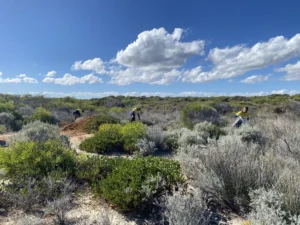
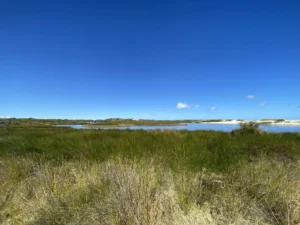
Subtropical and temperate coastal saltmarsh is recognised as a Threatened Ecological Community (TEC) under the Commonwealth’s EPBC Act (1999). Sharp Rush (or any other weed for that matter) threatens this recognition, as areas of coastal saltmarsh cannot comprise more than 50% weed species to meet TEC classification criteria. Sea Rush (Juncus kraussii) is a cousin to Sharp Rush but is native to Australia and is found in most areas of coastal saltmarsh in the NAR. Sharp Rush is known to hybridise with the native Sea Rush and so it is paramount to remove it from coastal saltmarsh systems as quickly as possible.
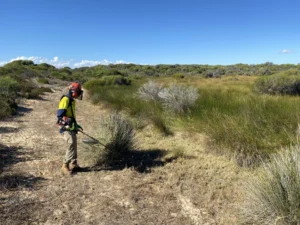
Blue skies and a light breeze set the stage for the team, first locating plants and removing the seed heads, each of which can carry 1000 seeds! This ensured plants had less chance to spread as they were trimmed down with whipper snippers before herbicide could be applied. The team will revisit the site in coming weeks to ensure that treatment was successful. Having extensive experience tackling nearby infestations of Sharp Rush, the KMAC team made light work of almost 80 plants, removing an estimated 450 litres of seeds!
A big thank you to the KMAC team for their expertise and efforts in helping NACC NRM improve the TEC of coastal saltmarsh at Hill River estuary – many hands make light work when it comes to tackling this thorn in our natural environment’s side!
This project is jointly funded by the Australian Government Natural Heritage Trust and NACC NRM, a member of the Commonwealth Regional Delivery Partners panel.