
The South West WA Drought Resilience and Innovation Hub (SW WA Hub), led by the Grower Group Alliance (GGA) receives funding from the Australian Government’s Future Drought Fund (FDF) to provide regionally focused information and support to adopt drought resilient practices that will better prepare farmers and communities for drought. NACC NRM’s Sustainable Agriculture team are leading the Geraldton Regional Node for the SW WA Hub into 2026, a role which has allowed the team to expand their networks and engage with stakeholders far and wide.
By Bridget Watkins – Regional Soil Coordinator, South West WA Drought Resilience and Innovation Hub
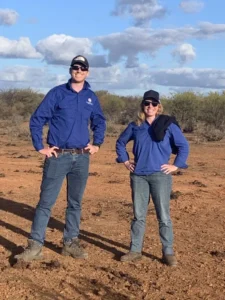
In early June 2025, Alejandro Carrillo, a cattle rancher from the Chihuahuan desert in Mexico, visited Gabyon Station, a cattle station 200 km east of Geraldton, to share his story about how they regenerated the pastures on their desert property, Las Damas. Coordinated by Sarah Jeffery from Agricultural Horizons, with support from RegenWA and hosted by Gemma and Helen Cripps at Gabyon Station, a group of pastoralists and industry representatives had the opportunity to hear Alejandro’s story and see what Gemma was putting into action on Gabyon.
At Las Damas, Alejandro’s family used to run 150 head of cattle across the 12,000 ha property and still had to supplement feed for 6 months of the year. Now they run a subdivided cell grazing operation where they shift a herd of 500 head of cattle daily and use adjustable electric fencing to allocate a cell size as is relevant to the feed on offer. Implementing this process means they can now carry 500 head throughout the year with as little as 150 mm annual rainfall, without destocking or supplement feeding, based on 3 features – a stockpile of grass, good genetics and a reliable water supply through bores to troughs.
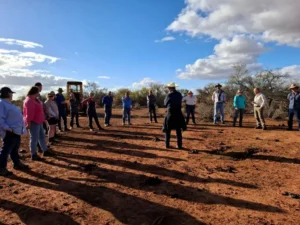
Photo: SoilsWest
Key messages from Alejandro:
- It’s easy to be a good farmer when it rains. Although when it does rain, it doesn’t rain grass. You still have to wait for growth.
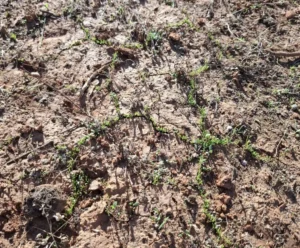
- Having more consistent grass cover promotes infiltration and makes the rainfall you do receive more effective, rather than run off causing erosion. More effective infiltration develops a system that self regenerates and is more resilient to drought and fire. If it does burn, it’s a gentler burn.
- Promoting infiltration rather than runoff will likely promote the grasses first, then the herbs will establish. Stock will put on more condition from herbs than grasses, although the mix is beneficial.
- Weeds and different plants will come into the system for a purpose, such as those with a strong tap root to break up the soil compaction. Once that process is achieved, other species establish, and the system will self-adjust.
- The value is in running a large herd, moved between grazing cells regularly then providing rest periods for the cells to recover. This concentrates the impact of the manure and urine – with the hoof action helping break up the surface crust and incorporate the manure into the topsoil. This is followed by a recovery period that allows rainfall to distribute that material into the system and for plants and seeds to regenerate. Make the recovery period for each cell as long as you can, ideally up to 12 months. This may be a progressive goal.
- There is value in a diverse herd with diverse grazing habits. Selective grazers and less selective grazers will spread the grazing pressure over the area.
- When you let the grass recover and it can grow out further, the root structure is stronger and the plant can recover faster after the next grazing occurrence.
- Grass that has grown out for longer periods has material at different growth stages of new and old growth. This provides more balanced nutritional requirements, supporting stronger immunity and reducing medication requirements for stock.
- You can operate with minimal water points for a large herd if the flow rate for the water to refill troughs is high. Monitoring the water is still essential though.
- Watch your stock, assess their condition, their behaviour, their grazing pressures. Consider how they are adjusting to the changes you implement.
- Manage the genetics of the herd by removing underperforming stock. Often 20% of the herd will cause 80% of the problems. Regularly remove the bottom 2% stock based on condition and performance. Put them in a separate rested holding paddock to regain condition until the next load of stock is taken for sale. Even though these animals may recover in a rested paddock where they aren’t being shifted daily, they were underperforming with normal working conditions, so it is better off to remove them from the herd.
Photos: SoilsWest
Make it work for you and your property – some guidance to start:
- Start with your most productive area – starting in your worst area takes time and money. Give the system the best chance for success initially then expand the program from there. Run the stock in larger mobs and move them more regularly.
- Water – use an existing water point if possible, subdivide the existing paddock into cells. If an existing water point isn’t possible, is a mobile water point such as water truck and trough an option? Ensure a high water flow rate and refill rate if using troughs so that all animals can drink when it is their turn.
- Fencing – how can you best use your existing infrastructure, what is the minimum new infrastructure you need to implement the system? Can you create subdivision cells within the existing fencing using polywire or electric fencing that you can shift?
- Rotational grazing – if you bring the stock back in too early, it will limit the success of the process. Extend the rest period as you can, e.g. if you’re currently giving 30 days rest, what do you need to do to extend it to 60 days rest? The following rotation, can you extend the rest periods out longer?
- Supplement feeding – perhaps you will still need to supplement feed at times but this should be decreasing year on year.
- Assess the stock – assess their condition, is the cell size you have provided for them sufficient, remove underperforming stock.
- Assess the vegetation – what are the grazing preferences? Does it change over time? Do new species establish in the cells during recovery or does the species composition change over time? Set up some photo monitoring points, monthly photos at set locations to track evidence of progress.
The benefit to soil
The aim is to promote the sustainable growth of vegetation that results in greater infiltration of rainfall and less erosion. The intensive short-term impact concentrates inputs from livestock, followed by the break period that allows that material to enter the soil system. More consistent vegetation growth results in better soil structure. By improving soil structure and promoting vegetation growth, the overall impact is a reduction in soil erosion, as the vegetation helps to bind the soil and the improved infiltration minimises surface runoff. Healthy soil with reduced erosion provides a better environment for plant growth, supports a diverse range of soil organisms, and helps maintain water quality.
Learnings from Gabyon Station – virtual fencing collars
- Using electric plain wire fencing to create grazing cells and shifting the fencing every 3 weeks was onerous on labour and the electric fence system earthed out during the hot summer months.
- Started using Gallagher eShepherd collars fitted to a herd of cattle in March 2025. The system was a high cost outlay at the start, but they have found the virtual fences are very effective. The collars have an inbuilt solar panel which makes them quite heavy. Gallagher recommends the collars for cattle weighing 200 kg or more.
- Mobile coverage requirements for the collars – base stations have been setup on Gabyon Station to relay data between the collars and the software used to manage the program.
- Currently running 172 head in 40 ha (2 km x 200 m) grazing cells for 5-7 days, then shifting to the adjacent cell by drawing up new polygons in the management software. Exclusion zones can be implemented using the software as well.
- A water truck with a trough has facilitated use of grazing cells without access to an existing water point. The truck uses an existing access track that forms one boundary of the virtual fence and is shifted 200 m to each new grazing cell.
- They found it was better to make the grazing cells smaller and move the cattle more regularly to prevent them losing condition walking as far from the water.
- All cattle need collars as uncollared cattle will lead others away. It is anticipated that younger calves will stay close enough with the herd without a collar.
- Need to monitor and assess the cattle, their condition, the vegetation condition and adjust movement schedule as required.
To read more, check out the full article on SoilsWest.
This article was featured in SAF Updates, a free newsletter tailored to those in the ag industry, brought to you by NACC NRM’s Sustainable Agriculture Facilitator (SAF).
To subscribe to this monthly resource, please contact Sustainable Agriculture Facilitator, Katrina Sasse.
E katrina.sasse@nacc.com.au | P (08) 9938 0110 | M 0447 361 335
Sustainable Agriculture Facilitators are supported by the Australian Government through funding from the Natural Heritage Trust under the Climate-Smart Agriculture Program.